Small enough to travel everywhere yet visible enough to reinforce a brand daily, embroidered polyester keychains are a practical promotional product when durability and presentation matter. Their value depends on more than logo placement: material weight, thread type, embroidery coverage, edge finishing, and hardware all affect how the finished piece looks and performs over time. This guide explains the key specifications buyers should review before production, from common 130mm x 30mm flight-tag formats to Pantone color limitations, rPET material options, and attachment upgrades. With the right choices, a simple keychain becomes a long-lasting brand identifier rather than a disposable giveaway.
Key Specifications for Promotional Polyester Embroidered Keychains
Promotional polyester embroidered keychains serve as highly durable, lightweight brand identifiers utilized across diverse industrial and commercial sectors. Their construction relies on a robust polyester twill base, ensuring resistance to abrasion, moisture, and ultraviolet degradation. To maintain structural integrity during daily use, manufacturers often fuse a non-woven backing or stiffener to the twill for single-sided designs, preventing the fabric from curling under physical stress. In contrast, true double-sided construction requires careful reverse-side finishing to conceal bobbin threads, significantly enhancing durability and perceived value beyond mere thread consumption.
Material, Size, and Embroidery Requirements
Standard dimensions typically range from 100mm to 150mm in length and 25mm to 35mm in width. This length range specifically describes tag-style or luggage-style keychains (such as aviation-style flight tags), rather than smaller traditional fobs. The 130mm x 30mm size often serves as a common benchmark for optimal text legibility and pocketability, though custom dimensions will vary. The embroidery process utilizes 120D or 150D polyester threads, chosen for their high tensile strength, minimal shrinkage, and exceptional colorfastness during industrial washing. For modern sustainability compliance, many buyers now specify recycled polyester (rPET) base materials and threads certified by OEKO-TEX to ensure the absence of harmful substances.
Buyers must specify their required embroidery coverage, generally offered at 50%, 75%, or 100% thresholds. A 100% coverage design fully conceals the base twill beneath a dense layer of thread, creating a rigid, premium finish, whereas lower coverage leaves the dyed twill background exposed to reduce costs. Edge finishing is critical for preventing fiber fraying; merrowed borders (overlock stitching) provide a traditional, raised, and highly durable edge. Alternatively, laser-cut borders are specified for complex, non-linear custom shapes, utilizing thermal energy to simultaneously cut and seal the synthetic polyester fibers.
Attachment Options and Branding Details
Hardware attachments must match the durability of the polyester body to prevent premature failure. The standard configuration utilizes a 25mm or 30mm nickel-plated steel split ring fastened through a brass or stainless steel eyelet. The eyelet is pneumatically pressed into the fabric, providing a reinforced anchor point that distributes mechanical stress. Attachment upgrades include zinc-alloy lobster clasps, aluminum carabiners, or black electrophoretic finishes suitable for tactical and outdoor applications.
Branding precision is guided by the Pantone Matching System (PMS). However, because embroidery thread libraries cannot replicate every Pantone shade exactly, buyers should request physical thread swatches or digitized proofs for color-critical brand compliance. While standard commercial embroidery machines can often accommodate up to nine simultaneous thread colors per design, limiting artwork to three or four colors generally ensures sharper text rendering. This limitation also minimizes thread tension issues and bulky knotting on the reverse side of double-sided keychains, resulting in a sleeker final product. Additionally, buyers should note that embroidery cannot reproduce photographic details or very fine color gradients, making it essential to adapt artwork for the medium. For optimal legibility, buyers should ensure a minimum embroidered text height of 4 to 5 mm and avoid ultra-thin line weights that needles cannot accurately reproduce.
How to Source Bulk Polyester Embroidered Keychains
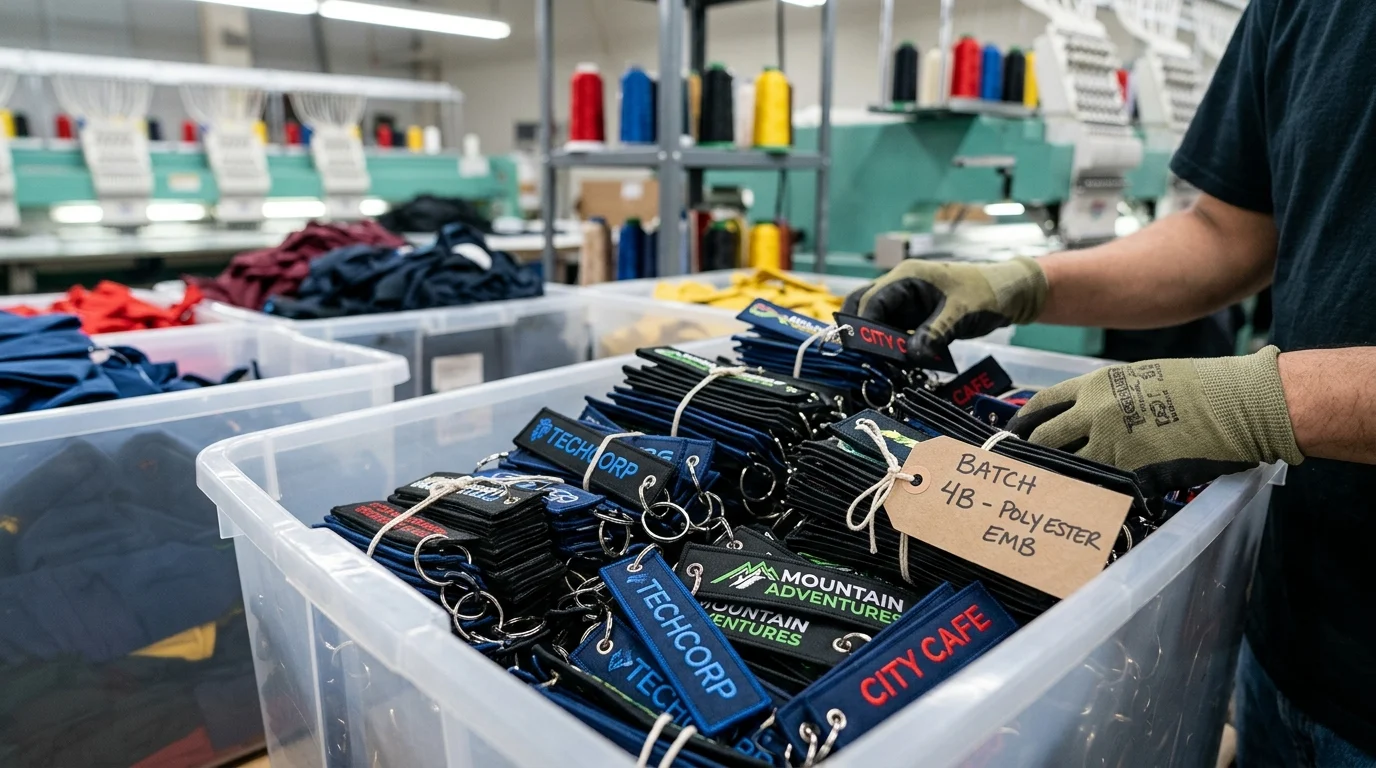
Procuring these items in commercial volumes requires a strategic approach to supplier selection, volume forecasting, and quality assurance. Buyers must evaluate overseas manufacturers based on their production capacity, compliance certifications, and precision in embroidery digitizing—the process of converting vector artwork into machine-readable stitch files. When sending vector files to overseas digitizing suppliers, it is highly recommended to establish clear agreements regarding intellectual property protection and artwork ownership to safeguard brand assets.
Cost Drivers and Minimum Order Quantities
Minimum Order Quantities (MOQs) for custom polyester embroidered keychains typically begin at 500 units, though estimates vary by supplier, region, and design complexity. Economies of scale often become highly advantageous at the 5,000-unit threshold. Unit costs are primarily driven by embroidery coverage, the inclusion of double-sided stitching, hardware upgrades, and initial digitizing setup fees. These fees usually range from $30 to $50 per design but are sometimes waived on bulk orders.
The following table provides illustrative benchmarks for pricing and lead times. Note that the “Standard Lead Time” reflects production days only; overseas ocean freight transit will add significant time to the total order cycle, which procurement planners must factor into their schedules.
| Volume Tier (Units) | Typical Unit Cost (USD) | Standard Lead Time | Recommended Transit Method |
|---|---|---|---|
| 500 – 1,000 | $0.65 – $0.95 | 10 – 14 Days | Air Express (Courier) |
| 2,500 – 5,000 | $0.45 – $0.60 | 15 – 20 Days | Air Freight |
| 10,000+ | $0.20 – $0.35 | 25 – 35 Days | Ocean Freight (LCL) |
Note: The unit costs above represent estimated factory-direct pricing and exclude landed-cost variables such as customs duties, VAT, and inland freight, which materially affect total procurement spend and sourcing decisions.
Specifying double-sided embroidery can add 15% to 25% to the base unit cost due to increased machine cycle times and higher thread consumption. Furthermore, specialty threads, such as metallic or glow-in-the-dark variants, can introduce an estimated 10% premium per unit.
Packaging conventions also impact logistics and landed costs. Specifying bulk polybags minimizes landed weight and freight expenses, whereas individual OPP bags offer better presentation for trade-show distribution but increase overall volume and storage requirements.
Sampling, Inspection, and Quality Control
Mitigating production risks necessitates a rigorous sampling and inspection protocol. A Pre-Production Sample (PPS) typically requires 5 to 7 days to manufacture. Buyers can opt for rapid digital approval via high-resolution photos or request physical delivery of the sample for tactile evaluation. This step is mandatory for verifying PMS color accuracy, stitch density, and small-text legibility before mass production commences.
Quality control is commonly enforced using the Acceptable Quality Limit (AQL) standard as a reference point, often targeting a Level II inspection with a 2.5 AQL for major defects and 4.0 for minor defects. Independent inspectors evaluate production batches for common manufacturing flaws.
How to Choose the Right Keychain for a Promotion
Use Case, Audience, and Campaign Fit
Selecting the optimal promotional product requires aligning the item’s physical characteristics with the target demographic and the specific marketing environment. For automotive, aviation, and outdoor apparel sectors, a promotional polyester embroidered keychain offers a tactile, lightweight alternative to heavy metal keyrings that might scratch ignition panels or add unnecessary bulk.
When evaluating campaign fit, procurement managers must assess the expected lifecycle of the giveaway. High-frequency use items demand durable materials that maintain brand visibility over time without degrading. Fabric keychains resonate particularly well with audiences that value utility and active lifestyles, as they can be easily attached to backpacks, luggage, or sporting equipment without adding noticeable weight.
When Polyester Embroidery Is the Best Option
Polyester stands out in the promotional merchandise sector due to its high tensile strength and resistance to fading. According to standard textile manufacturing data, polyester threads retain dye significantly better than natural fibers under prolonged UV exposure, making them highly suitable for outdoor applications. A promotional polyester embroidered keychain becomes the superior procurement choice under several specific conditions:
- Direct Mail Campaigns: The minimal weight of fabric keychains significantly reduces postal shipping costs compared to metal or heavy plastic alternatives.
- Surface Protection: Soft fabric entirely eliminates the risk of scratching sensitive surfaces, which is a mandatory safety and quality requirement for motorcycle, marine, and premium automotive brands.
- High-Volume Distribution: The automated multi-head embroidery process ensures rapid production times and strict design consistency for large-scale trade show giveaways.
Key Takeaways
- Use 100mm to 150mm length and 25mm to 35mm width as the typical specification range for tag-style promotional embroidered keychains.
- Choose a 130mm x 30mm format when you need a practical balance of readable branding, pocketability, and production efficiency.
- Limit artwork to three or four thread colors to improve text clarity and reduce bulk or tension problems in embroidery.
- Request physical thread swatches or digitized proofs because embroidery threads cannot always match Pantone colors exactly.
- Select merrowed borders for traditional durability, but use laser-cut borders when the design requires complex custom shapes.
- Specify rPET materials and OEKO-TEX-certified threads when sustainability compliance and safer material sourcing are purchasing priorities.
Frequently Asked Questions
What size is best for a polyester embroidered keychain?
For tag-style or flight-tag keychains, 130mm x 30mm is a common benchmark because it balances text legibility, comfort in a pocket, and enough branding space.
What is the difference between 50%, 75%, and 100% embroidery coverage?
Coverage refers to how much of the fabric is covered by thread. Lower coverage shows more dyed twill and can reduce cost, while 100% coverage creates a denser, more premium, rigid finish.
Are double-sided embroidered keychains more durable?
They can be, if constructed properly. True double-sided designs require reverse-side finishing that hides bobbin threads and improves both durability and perceived quality.
Which edge finish should I choose?
Merrowed borders are ideal for a raised, traditional, durable edge. Laser-cut borders work better for complex custom shapes because the heat cuts and seals polyester fibers at the same time.
Can embroidery match exact Pantone brand colors?
Not always. Thread libraries may not perfectly match every Pantone shade, so buyers should request physical thread swatches or digitized proofs for color-critical branding.