Silent audio technology has become a practical tool for event teams that need both crowd engagement and noise control. Multi-channel RF headsets allow hundreds of attendees to choose between different audio streams without loudspeakers, helping organizers manage municipal sound limits, crowded venues, and multilingual programming. When combined with custom branding and three-color LED channel indicators, the headset becomes more than rental hardware—it becomes a mobile sponsorship asset and an operational signal for staff. This article explains where these systems work best, how RF channel architecture differs from consumer audio solutions, and which specifications buyers should review before ordering for festivals, conferences, fitness events, or corporate activations.
Why Branded Multi-Channel Silent Disco Headsets Matter
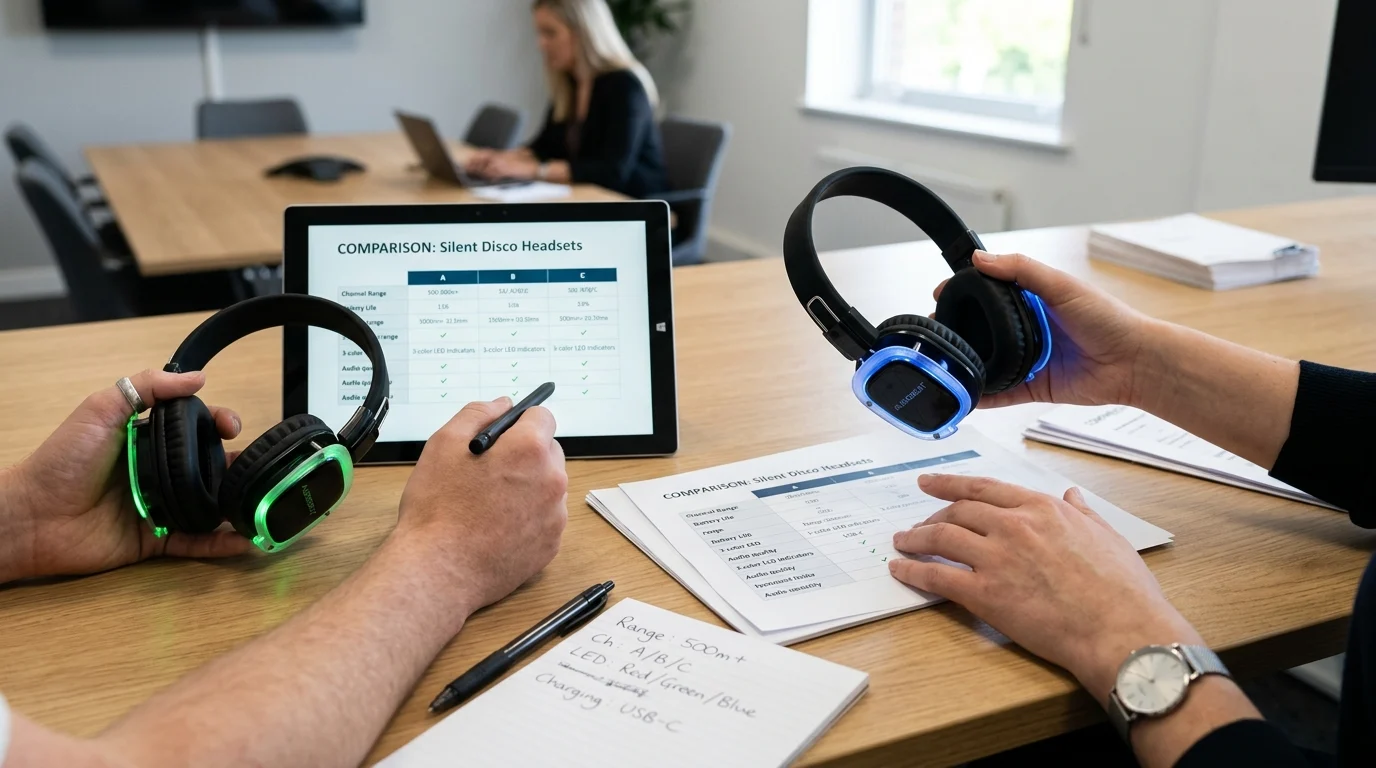
Branded multi-channel silent disco headsets merge acoustic management with experiential marketing. For event organizers and equipment rental enterprises, these devices provide a practical way to comply with strict municipal noise ordinances while functioning as a mobile canvas for corporate branding. The integration of three-color LED lighting tied directly to specific audio channels draws attention to printed logos on the earcups. This visual element allows attendees to instantly signal their listening choices, encouraging social engagement without contributing to ambient noise pollution. Note, however, that LED channel indicators may be difficult to see in bright daylight, making them most effective for evening, shaded, or indoor events.
Defining Multi-Channel RF Audio for Buyers
Multi-channel radio frequency (RF) audio relies on ultra-high frequency (UHF) transmission to deliver low-latency sound. Depending on the hardware, RF systems may be analog, compressed, or codec-dependent, so buyers should verify audio specifications with manufacturers rather than assuming uncompressed fidelity. Commercial headsets typically operate within the 863–865 MHz band in Europe or the 900–928 MHz ISM band in North America. While these bands are common, they are not universally license-free. Permitted frequencies vary by country, and professional RF deployment may require specific licensing or local frequency coordination. High-density venues with heavy metal structures or competing signals may also require additional transmitters to prevent dropouts. Unlike consumer Bluetooth devices with pairing bottlenecks, a single professional RF transmitter can broadcast to hundreds of headsets simultaneously, depending on transmission power and environmental factors.
The standard commercial configuration features three distinct channels. This architecture allows organizers to broadcast three entirely different audio streams—such as competing DJs, separate panel discussions, or distinct musical genres—within the exact same physical footprint without cross-channel interference.
Best Commercial Use Cases
The commercial applications for these headsets extend far beyond traditional music festivals. In corporate environments, event planners deploy sponsor-branded headsets for breakout sessions on crowded trade show floors, eliminating the need for costly soundproof partitions while giving sponsors direct exposure to attendees. Fitness operators utilize multi-channel systems for outdoor yoga or spin classes where amplified sound is prohibited by local ordinances, maintaining an immersive audio environment for participants.
Additionally, international multi-language conferences leverage the three-channel capability for real-time translation services. By assigning a functional LED color to each language stream—for example, red for English, blue for Spanish, and green for Mandarin—event staff can seamlessly manage logistics and ensure delegates are tuned to the correct audio feed without disruption.
Key Specifications to Compare
Evaluating silent disco headsets requires a rigorous analysis of acoustic performance metrics and hardware resilience. Commercial buyers must balance audio fidelity with the practical demands of high-volume deployment, where equipment is subjected to continuous physical stress and rapid user turnover. Buyers must also account for deployment caveats, such as potential RF interference in dense venues. While UHF signals do not strictly require a clear line-of-sight to function, physical obstacles, competing RF signals, and transmitter antenna placement can severely reduce the effective transmission range.
Channel Count, RF Range, and Audio Quality
Professional-grade RF transmitters often advertise a stable signal across an illustrative radius of 300 to 500 meters in open air, though real-world performance depends heavily on the venue. To achieve stability, systems utilize phase-locked loop (PLL) technology to prevent frequency drift. Audio quality is primarily dictated by the signal-to-noise ratio (SNR) and total harmonic distortion (THD). As general market benchmarks, buyers might look for an SNR of greater than 75dB and a THD below 1% for clear vocal reproduction, but teams must always verify these specifications against supplier datasheets.
The standard three-channel setup is visually indicated by integrated LED lights, typically illuminating red, green, and blue. This 3-color LED system allows users and operators to identify which audio feed is active across a dark venue. Operators must carefully distinguish between these functional channel-indicator LEDs and any custom static LED colors used purely for branding, as mixing the two could confuse attendees.
Battery Life, Durability, and LED Color Modes
Operational uptime is a critical factor for high-turnover rental fleets. Commercial headsets are typically equipped with rechargeable lithium-ion batteries ranging from 400mAh to 600mAh. A 600mAh capacity generally delivers 10 to 12 hours of continuous playback at maximum volume with active LED illumination. Depending on the manufacturer, these batteries are often rated for an illustrative 500 full charge cycles before exhibiting significant capacity degradation; buyers should confirm exact lifecycle ratings with suppliers. Durability relies heavily on industrial-grade ABS plastic housings and steel-reinforced headbands capable of withstanding the torsional strain of rapid distribution.
| Specification | Standard Consumer Grade | Professional Commercial Grade |
|---|---|---|
| RF Transmission Range | 100 – 150 meters | 300 – 500 meters |
| Battery Capacity | 300mAh (6-8 hours) | 600mAh (10-12 hours) |
| Speaker Driver Size | 30mm | 40mm Neodymium |
| Signal-to-Noise Ratio | > 60dB | > 75dB |
| Ear Pad Material | Standard Foam | Protein Leather (Replaceable) |
Note: The values above are representative examples rather than universal industry standards. Always verify exact specifications against supplier datasheets.
How to Source, Brand, and Deploy Headsets
Successfully integrating branded headsets into an equipment portfolio requires strategic procurement and meticulous supply chain management. The transition from raw hardware to a cohesive brand asset involves precise customization techniques and rigorous vendor vetting to ensure regulatory compliance and operational reliability. Furthermore, successful deployment necessitates planning for strict hygiene workflows, secure transport, and efficient battery-charging logistics.
Logo Application and Supplier Checks
Custom branding on silent disco headsets is typically executed via precision pad printing or UV printing directly on the outer plastic earcups. Beyond earcup logo printing, comprehensive branding options can include custom LED color presets, headband printing, custom packaging, and even pre-branded audio channel announcements. UV printing is highly recommended for commercial use, as it provides superior resistance against scratches and fading.
Key Takeaways
- Use three-channel silent disco headsets to run separate DJs, languages, or presentations in one shared venue without increasing ambient noise.
- Choose branded earcups when sponsor visibility matters, because the illuminated headset design draws attention to logos during live events.
- Verify local RF regulations before deployment, since common bands such as 863–865 MHz and 900–928 MHz are not license-free everywhere.
- Plan transmitter placement carefully in metal-heavy or crowded venues, as obstacles and competing signals can reduce effective RF range.
- Schedule LED-focused activations for indoor, shaded, or evening settings because three-color channel lights are less visible in bright daylight.
Frequently Asked Questions
What are multi-channel silent disco headsets used for?
They let organizers broadcast multiple audio streams to wireless headsets in the same venue, making them useful for silent discos, trade show sessions, fitness classes, conferences, and multilingual events.
How do the three LED colors help at events?
The LEDs indicate which audio channel a listener has selected, making it easier for staff and attendees to identify channels visually. They are most effective indoors, in shaded areas, or at evening events.
Can these headsets be branded with a company logo?
Yes. Branded earcups turn each headset into a visible promotional item, especially when channel LEDs draw attention to the headset during corporate events, sponsorship activations, or rental deployments.
Do RF silent disco headsets work better than Bluetooth for large events?
For large groups, professional RF systems are usually more practical because one transmitter can broadcast to hundreds of headsets, while Bluetooth systems often face pairing and capacity limitations.
Which frequencies do commercial silent disco headsets use?
Many systems use 863–865 MHz in Europe or 900–928 MHz in North America, but rules vary by country. Buyers should confirm local frequency regulations before deployment.